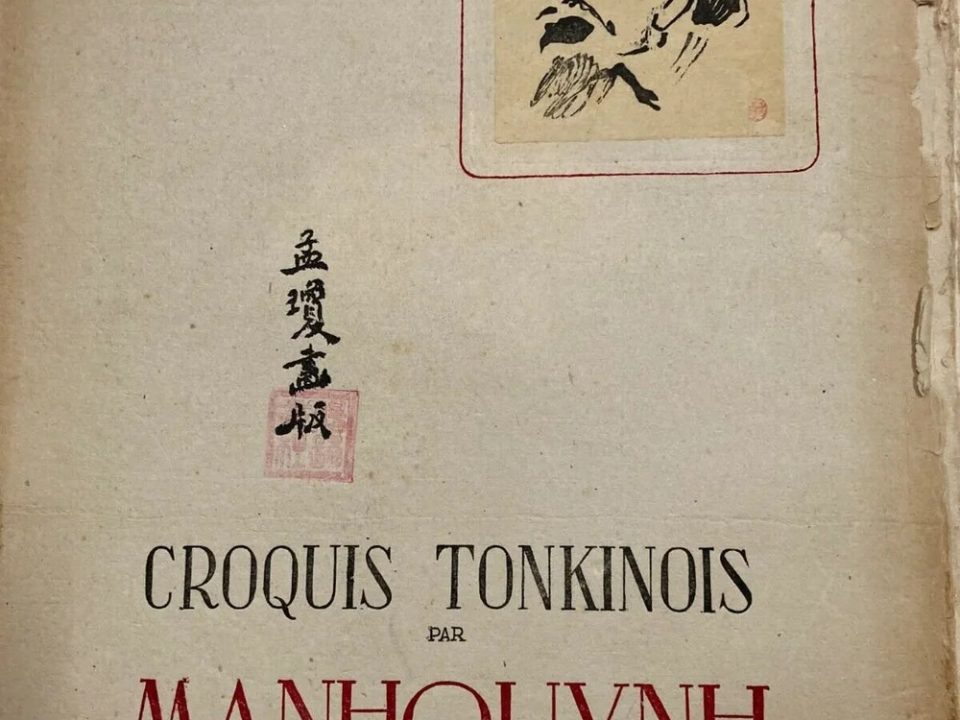
Modern Vietnamese visual art began to flourish with the establishment of the École des Beaux-Arts de l’Indochine (Indochina College of Fine Arts), where many talented artists emerged. They became the pioneers who laid the first bricks for the foundation of modern Vietnamese art. One notable figure of that generation is Professor and painter Ngô Mạnh Quỳnh. When people mention Mạnh Quỳnh, they not only recall his lacquer works, ink wash paintings, or his role in designing Vietnam’s first paper currency — but also remember him as one of the trailblazers in the field of Vietnamese illustration.


Books illustrated by Mạnh Quỳnh in 1942 and 1943.
Illustration is a genre within graphic art. It is meant to clarify, enliven, or visually enhance the content of literary works or written text, using drawings or other easily perceived and emotionally resonant visual elements. In his book The Eye That Sees Beauty, Nguyễn Quân wrote:
“With the advent of printing, journalism, and the book publishing industry, illustration began to develop. It served literary works, cultural, scientific, and social articles… Before photography existed, all visual elements in the press relied on illustration.”
Ngô Mạnh Quỳnh (1917–1991), born in Hanoi, demonstrated his artistic talent in illustration as early as his high school years at Gia Long School (1936–1939). At that time, he created his first satirical cartoon illustrations, published weekly in the Đông Pháp Daily. Later, after graduating from the École des Beaux-Arts de l’Indochine in 1942, he became renowned in the illustration world for his work in the children’s newspaper Cậu Ấm and the Vietnamese translation of La Fontaine’s Fables.
Although he graduated with distinction thanks to his lacquer painting Going to the Pagoda, his career became inseparably linked with illustration. Mạnh Quỳnh became famous for his poetic style of illustrating verses using delicate brushwork with Chinese ink on silk, crafting a style imbued with Vietnamese cultural identity. For him, the freedom of creative space in illustration — unconstrained by strict rules of perspective or anatomical precision — was deeply enjoyable. Through his illustration work, Mạnh Quỳnh established a distinctive artistic style and personal expression. He immersed himself in characters and lines with a mindset that breathed soul and the rustic beauty of Vietnamese countryside into children’s stories — using a joyful, humorous, and familiar drawing style.


Artist Mạnh Quỳnh directed the animated film “Tí Hon”, produced by Hạ Long Studio in 1952–1953.
With expressive brush lines and an unrestricted visual language, Mạnh Quỳnh vividly recreated scenes of rural life in old Vietnam. Even in the translated French collection La Fontaine’s Fables, deeply rooted in French culture, his illustrations were fully “Vietnamized.” From thatched roofs and betel trees to children with traditional topknots, women in four-panel tunics carrying conical hats, or the exaggerated mannerisms of Lý Toét and Xã Xệ — classic caricatures of Vietnam’s old feudal society — all were rendered with wit and humor.

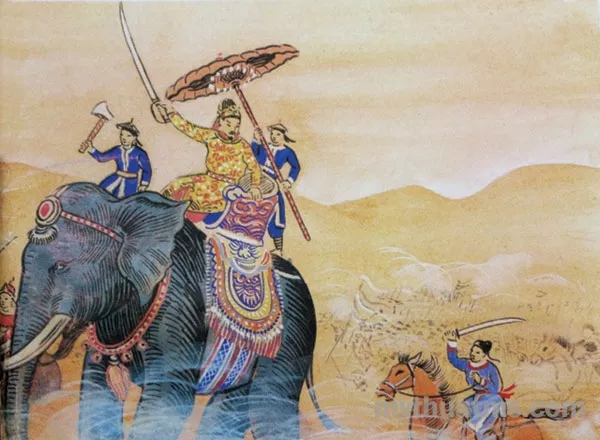
Cover illustration for the book “The Lam Sơn Uprising”, illustrated by artist Mạnh Quỳnh.

Cover illustration for the book “The End of the Trần Dynasty”, illustrated by artist Mạnh Quỳnh.
Each character’s facial expression and body language was brought to life through quick, bold, and nuanced brushwork. Just a glance at his illustrations could convey the essence of the accompanying text.
As someone who loved children deeply, Mạnh Quỳnh personally handled all aspects of publishing Thiếu niên họa báo (Children’s Illustrated Magazine): writing, drawing, printing, and distribution. In it, he poured his affection for younger generations through characters filled with humanistic spirit. For instance, the character Kaoco emerged as a heroic child figure, overcoming hardships with compassion and courage. Other characters — Vá, Vếu, Khỏe — embodied rustic Vietnamese charm: honest, naïve, caught in daily mishaps that created lighthearted, comedic situations. The people in Mạnh Quỳnh’s illustrations were familiar faces from daily life, representing the lower strata of Vietnamese society. His illustrations also played a role in spreading Vietnamese culture and art internationally, especially through translated books.
In short, Mạnh Quỳnh contributed significantly to preserving and promoting Vietnamese traditions. He enriched Vietnamese illustration with cultural identity and inspired a patriotic spirit in younger generations to come.
Le Hoa
Original link: mythuatms.com