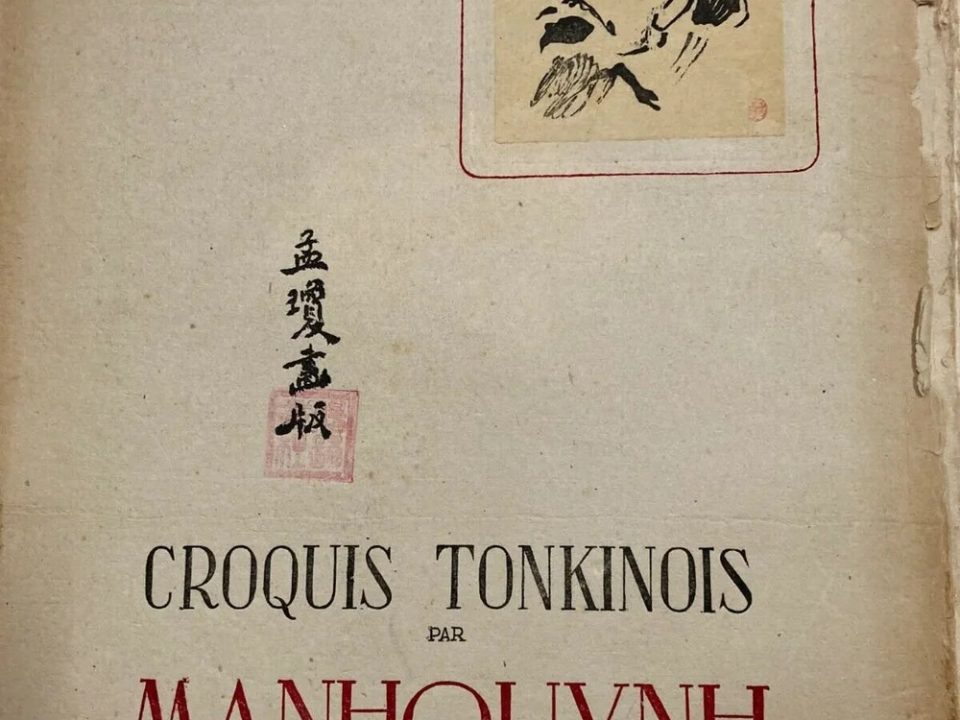
Mention the name Ngô Mạnh Quỳnh, and many people recall not only an artist who studied alongside great names like Trần Văn Cẩn, Tô Ngọc Vân, and Nguyễn Gia Trí, but also a renowned illustrator for numerous publications—especially those geared toward children.
According to family members, during the French colonial era, he collaborated with several newspapers and worked on literary books. At just 17 or 18 years old, he was already illustrating the comic strip Kaoco. By 1935, he had become the lead illustrator for the children’s newspaper Cậu Ấm – Cô Chiêu. His works Lên chùa (Going to the Pagoda) and Chùa Thầy (Thầy Pagoda) are lacquer masterpieces on par with those of Nguyễn Gia Trí and Lê Quốc Lộc. His illustrations for La Fontaine’s fables were especially lively and infused with a distinctly Vietnamese character.

Poet Vũ Đình Liên remarked, “Students memorized La Fontaine partly thanks to Ngô Mạnh Quỳnh’s illustrations for this fable collection.” In his illustrations for Truyện Kiều, he depicted modern women dressed in the Cát Tường áo dài—a precursor to the modern Vietnamese áo dài.
Later in life, he was also the first person to create animated films using paper cutouts—starting with Thạch Sanh—and the first to establish a puppet theater troupe for children. He also illustrated the first two banknotes issued by the Democratic Republic of Vietnam.
Driven by a desire to preserve the soul of the nation through traditional art, in 1947, within the Việt Bắc Resistance Zone, he established a lacquer painting workshop. The revolutionary life of President Hồ Chí Minh was a recurring source of creative inspiration for Ngô Mạnh Quỳnh. Devoted to Vietnamese history and culture, he illustrated works such as Chinh phụ ngâm, Lục Vân Tiên, and especially Kim Vân Kiều truyện, which were met with enthusiastic readership.
Eighty years later, his illustrations for Kim Vân Kiều were selected for an exhibition commemorating the 250th birth anniversary of Nguyễn Du, during which the great poet was recognized by UNESCO as a World Cultural Figure.
In 1990, Mr. Bùi Văn Bảo in Canada compiled a 20+ volume series titled Vietnamese History Through Pictures. All the illustrations in this series were done by Ngô Mạnh Quỳnh, and the books were published in three languages—Vietnamese, English, and French—by Quê Hương Publishing House. He was also a master of traditional ink wash painting, establishing a distinctively Vietnamese style in the medium.
Recalling fond memories of his older brother, Mr. Ngô Đình Châu shared:
“I remember when we were young, while my brother painted, I would grind ink for him. He used cat-hair brushes, and our father often brought him brushes and inksticks from Yunnan.”
“My brother bought art instruction books for children and made me and our younger brother study them. He wanted us to follow in his footsteps. I didn’t like painting and often got scolded, but our younger brother loved it—and later became a successful artist: Ngô Đình Chương.”
Around 1951, Ngô Mạnh Quỳnh founded a puppet troupe that performed at the Hanoi Opera House and also opened an art class on Hòa Mã Street. He even planned to launch an animation studio, though that dream never materialized due to various challenges.
Born into a middle-class family in Hanoi, he completed high school at the prestigious Bưởi School and then entered the École des Beaux-Arts de l’Indochine. After graduation, he taught, produced books and newspapers, and created educational materials for children.
To commemorate the 100th anniversary of his birth (1917–2017), his family compiled a collection of paintings, photographs, and documents detailing his life in the book Ngô Mạnh Quỳnh: The Artist – Life and Artistic Career. The book includes many rare materials, among them a letter from Prime Minister Phạm Văn Đồng dated September 7, 1974, addressed to the artist:
“On the occasion of expressing my gratitude to the artist, I feel compelled to remind all those working in the arts: Our country is beautiful, our people are beautiful, our cause is beautiful, and so the soul of the artist must also be beautiful in order to create beautiful works.”
Those words, spoken 43 years ago by the late Prime Minister, still hold true today. Throughout his life, Ngô Mạnh Quỳnh stayed true to that spirit in both his art and his dedication to his homeland. The newly published book includes 24 paintings showcasing the beauty of Vietnam—from the iconic Hoàn Kiếm Lake, the heart of the capital, to vibrant scenes of rural village life.
Artist Thẩm Đức Tụ—one of Ngô Mạnh Quỳnh’s first students and later Chairman of the Hanoi Fine Arts Association—wrote in the book’s preface:
“A great talent—an exemplar of Vietnamese integrity. He left future generations with an invaluable legacy.”
Original link: https://thoibaonganhang.vn/nguoi-hoa-si-cua-the-gioi-tuoi-tho-59978.html