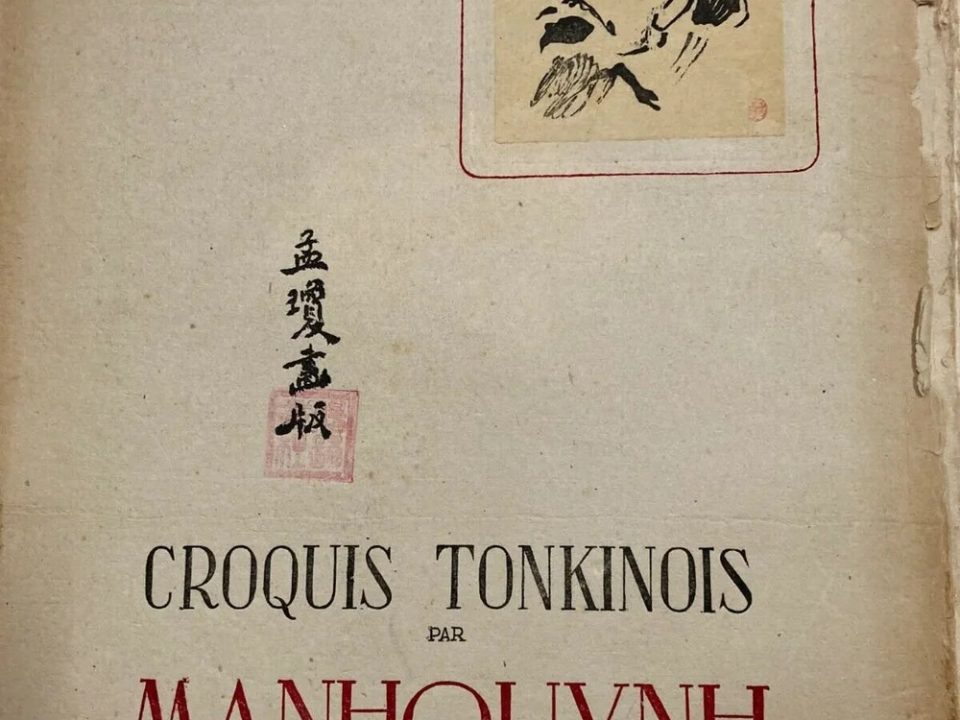
Strangely, although Mạnh Quỳnh was a pioneering figure in the field of comic illustration in Vietnam, there is remarkably little documentation about him.
Yet, in the memories of those from his generation, his presence remains vivid and towering. People often recall him with deep admiration. Poet Thy Ngọc, now in his 80s, reminisced:
“When I was in third or fourth grade in primary school, painter Mạnh Quỳnh was already famous. At the time, he illustrated adventure comics with mysterious titles like Kao Co and created characters like Vá and Vếu for the children’s magazine Cậu Ấm – Cô Chiêu, run by Thái Phỉ (Nguyễn Đức Phong).”
Based on my research, Cậu Ấm – Cô Chiêu was the very first children’s magazine in the history of Vietnamese journalism. From issue No. 1 to 12 (starting May 8, 1935), it was titled Cậu Ấm – Boys’ Magazine. From issue No. 13 (May 15, 1935) onward, the name was changed to Cậu Ấm – Cô Chiêu (The Little Lord – The Little Lady). The editorial office was located at 82 Rue du Coton (now Hàng Bông Street – Hanoi). The paper was printed in a 19×29 cm format and was 20 pages long. Painter Mạnh Quỳnh was the principal illustrator for the publication.
Poet Thy Ngọc continued:
“Mạnh Quỳnh, whose family name is Ngô, left an impression on me with his tall figure. He was not very talkative, but always youthful and cheerful, inspiring a sense of trust in those who met him. Besides comic illustration, he was the first to create motionless ‘films’ (slideshows) shown at the Hạ Long photo studio.
At that time, there were no animated videos, so we children were utterly captivated by his ‘films.’ At some point—I’m not sure when—he opened a private drawing class at his house on Hàng Trống Street, previously located on Nhà Thương Khách Street. Many now-famous artists were once his students.”
It is touching that, even at an advanced age, poet Thy Ngọc—who has spent more than 50 years writing poems and stories exclusively for children—recalled Mạnh Quỳnh as if it had all happened just yesterday.
Thy Ngọc also shared that Mạnh Quỳnh was the illustrator for the fables of the French poet Jean de La Fontaine (1612–1695).
The first time La Fontaine’s name appeared in Vietnam, it was rendered into Sino-Vietnamese as “Lã Phụng Tiên,” and his works were translated into Vietnamese using the modern quốc ngữ script in the book Hải Lục Cách Ngôn, edited by Đỗ Thận, printed by H. Schneider’s press, and sold at the Ích Ký bookstore (58 Hàng Giấy – Hanoi) during the time of the Đông Kinh Nghĩa Thục movement.
The first fable to appear in a quốc ngữ newspaper was The Story of the Wolf and the Lamb, published in Đại Nam Đăng Cổ Tùng Báo (Issue No. 821, Thursday, October 10, 1907), translated by writer Nguyễn Văn Vĩnh (1882–1936).
Later, Nguyễn Văn Vĩnh compiled the fables he had translated into a volume titled La Fontaine – Fables in Verse, published by Trung Bắc Tân Văn in 1928. It featured 44 fables, all illustrated by Mạnh Quỳnh. His illustrations were rich with Vietnamese scenery and people.
We have not been able to locate a copy of the original 1928 edition, but fortunately, we do have a reprinted version published by Cảo Thơm Publishing House in South Vietnam in 1969.

Looking through La Fontaine – Fables in Verse, one finds great delight. For example, in the fable The Middle-Aged Man and His Two Mistresses, Mạnh Quỳnh illustrated the man wearing a Vietnamese khăn đóng (traditional turban) and holding an umbrella, while the women wear khăn mỏ quạ (a traditional headscarf) and hold fans.
In The Milkmaid and Her Pail, the main character Perrette is drawn to resemble a rural Vietnamese girl from the early 20th century.
Knowing this, one imagines La Fontaine would be pleased—after all, if his fables achieved universal appeal, then it’s only natural for each culture to interpret the characters through its own lens.
The messages of these fables—such as “Never sell a bear’s skin before you’ve caught it,” “Speed is useless unless you start at the right time,” “Doubt is the mother of safety,” or “A hungry belly has no ears”—are not only understood by the French, but by Vietnamese readers as well.
In particular, the animals in La Fontaine’s stories come to life in the whimsical style of Mạnh Quỳnh’s illustrations. Even ferocious creatures like lions and wolves are drawn with smiling faces—and how lovable they look!
It is precisely this uniquely expressive style that sets Mạnh Quỳnh apart. Even today, in Vietnam, no other artist has illustrated La Fontaine’s fables more superbly than he has.
According to poet Thy Ngọc, Mạnh Quỳnh was likely born before 1920 and passed away just a few years ago in Hanoi.
Le Minh Quoc
Original link: https://tannamtu.id.vn/?p=5564