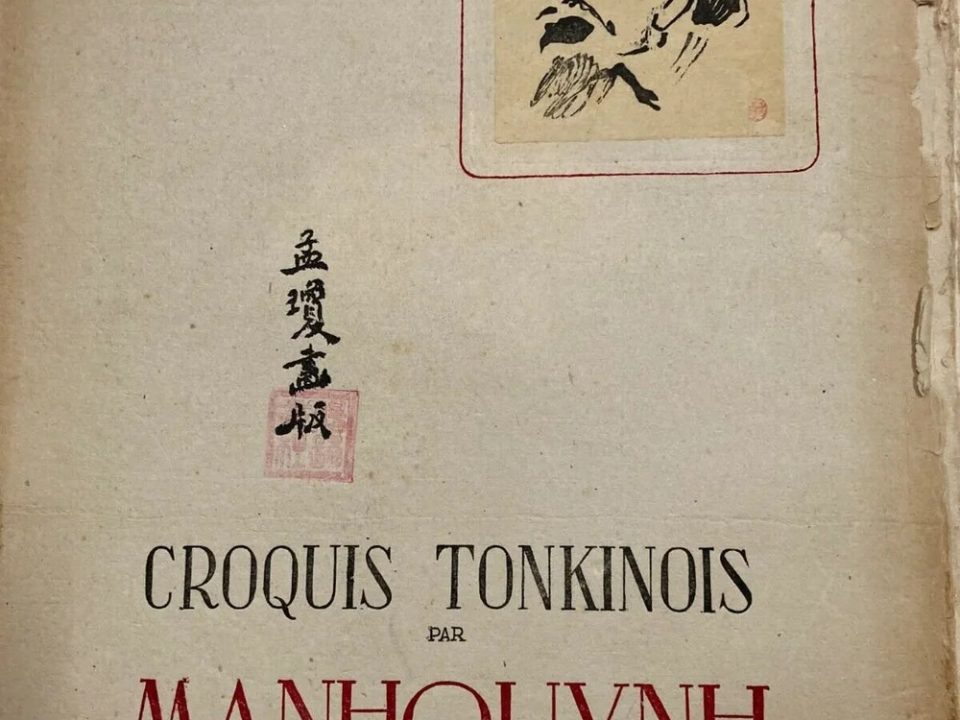
Mạnh Quỳnh is often known for his comic strips published in Cậu Ấm Cô Chiêu, the first children’s newspaper in the history of Vietnamese journalism, founded by Thái Phỉ (Nguyễn Đức Phong) in 1935. The paper featured two main characters named Vá and Vếu and was printed in a 19 x 29 cm format with 20 pages per issue.
He also became well known for his illustrations in the Fables of La Fontaine, translated by Nguyễn Văn Vĩnh. The finest edition of this work was published by Alexandre De Rhodes Publishing House in Hanoi in 1943. His illustrations are rich with Vietnamese landscapes and people—such as in the opening fable The Cicada and the Ant—imbuing the foreign stories with unmistakable local flavor.

In the same collection by Alexandre De Rhodes Publishing House, Mạnh Quỳnh also illustrated Vietnamese classical works such as The Lament of the Warrior’s Wife (Chinh phụ ngâm), The Poor Woman’s Lament (Bần nữ thán), The Six Beasts Compete in Merits (Lục súc tranh công), and The Catfish and the Toad (Trê cóc). Notably, he also illustrated The Tale of Kiều by Nguyễn Du, translated into French by Nguyễn Văn Vĩnh.
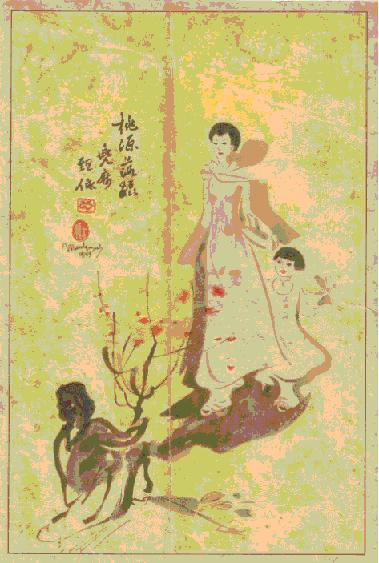
These illustrations were often simple line drawings—unlike his elaborate painting for Nguyễn Du’s verse: “Lost in Peach Blossom Spring, how did she wander here?” from The Tale of Kiều.
This particular artwork is little known today, as it was not featured in Vietnamese New Year publications but rather appeared in the French-language Indochine magazine, published in Hanoi in early spring of the Year of the Rooster (1933).
In the painting, Mạnh Quỳnh depicted a Vietnamese woman of the 1930s in a tân thời (modern) áo dài with a “san” scarf (châle) wrapped around her neck. This outfit, then called the Cát Tường áo dài—named after the designer, or as a playful twist on the French name Le Mur (“The Wall”)—was a major evolution from the traditional tứ thân dress. The redesign reduced the four-panel gown to just two panels (front and back), elongated to flow below the knees to create an elegant, graceful silhouette. The upper part was tailored to gently hug the wearer’s curves, enhancing both elegance and sensuality.
To be fashionable, the Le Mur áo dài had to be worn with white satin trousers, rather than the traditional black. At the time, this modern fashion faced criticism from conservatives, who saw it as improper.

Đào nguyên lạc lối đâu mà đến đây
Later, painter Lê Phổ made a few stylistic tweaks, and the áo dài as painted by Mạnh Quỳnh essentially became the standard form still seen today. Women at the time still wore their hair in chignons—not yet permed as in modern styles. The white áo dài symbolized purity and grace, as poet Huy Cận once described:
A plain white dress, a dream pure and light,
You came that day, eyes soft and bright.
With blooming radiance—your steps drew near,
Fragrant footprints, rosy steps appear.
Mạnh Quỳnh not only painted this elegant woman in her white áo dài, but also included a little girl beside her, also wearing a Vietnamese áo dài—not a Western dress, as young girls often wear today.
The scene of a beautiful woman appearing before a flower vendor evokes the image of a fairy, lost from the fabled Peach Blossom Spring. It’s a fitting illustration for Nguyễn Du’s line about springtime wanderers, and Quỳnh even wrote it in beautifully flowing chữ Nôm script.
We are fortunate to have preserved this painting, and on this spring occasion—exactly 70 years later—we are pleased to share it for readers to enjoy.
Notes:
- While men’s áo dài remained largely unchanged, the traditional tứ thân for women was reformed by Le Mur into the fashionable Le Mur áo dài, marking a milestone in Vietnamese women’s fashion.
- According to Nguyễn Văn Vĩnh, he translated La Fontaine’s fables at a young age, before he ever wrote poetry. Yet inspiration helped him shape the verses into rhyme. He noted that his aim was to preserve the spirit, not the literal meaning. For instance, he might replace “tiger” with “lion,” or “stick” with “dog.” These translation liberties remained untouched in the 1943 printed edition.
Nguyen Quang Tuan