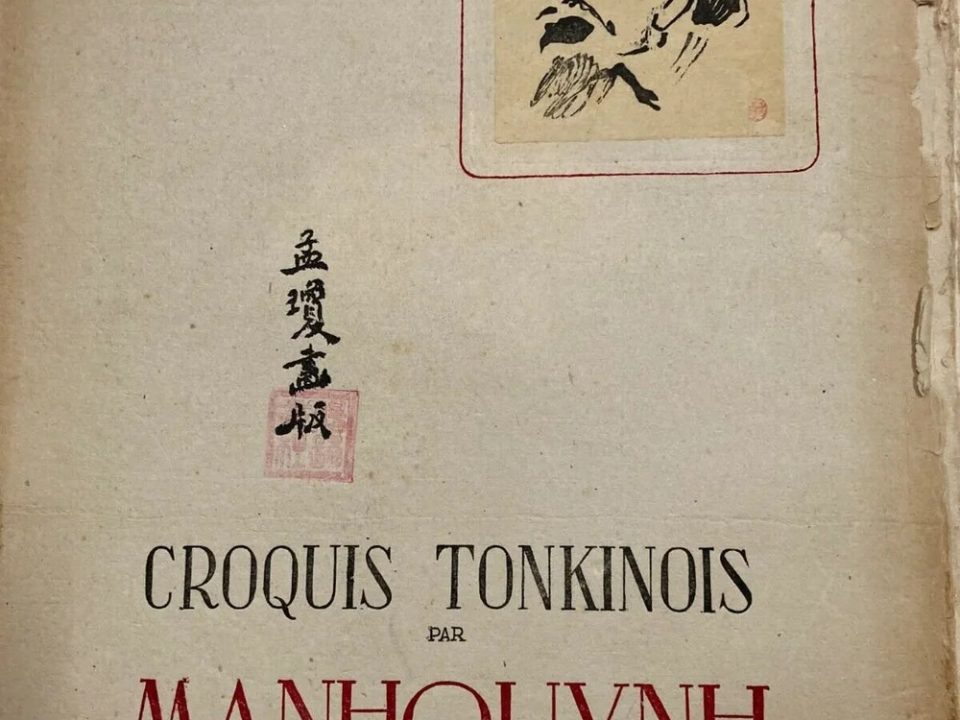
In celebration of the 100th anniversary of artist Mạnh Quỳnh’s birth (1917–2017), a native of Hanoi, his children compiled his paintings, illustrations, and archival materials into a commemorative book titled “Mạnh Quỳnh – The Artist: A Life in Fine Arts.” Flipping through its 160 large-format, carefully printed pages, readers gain deeper insight into a remarkable life.


In the early 1970s, the face of artist Mạnh Quỳnh frequently appeared on Vietnam Television’s “Những bông hoa nhỏ” (“Little Flowers”) program, broadcast at 7:00 p.m., where he taught children how to draw. His gentle demeanor and simple, approachable style left a lasting impression on viewers and young learners. At the time, many only knew him as an art teacher. It wasn’t until his sudden passing on April 2, 1991, when articles appeared in national and Hanoi newspapers reflecting on his vibrant career, that the public came to recognize him as a “rich vein” of creative output in the world of Vietnamese art.
Gifted with extraordinary talent, Mạnh Quỳnh passed the entrance exam into the Lacquer Painting Department of the École des Beaux-Arts de l’Indochine (Indochina College of Fine Arts) in 1935. Artist Lê Minh Quốc noted that even then, Mạnh Quỳnh was already the principal illustrator for the children’s newspaper “Cậu Ấm – Cô Chiêu” (“The Little Gentleman – The Little Lady”). Upon graduating in 1942, he completed works such as “Lên chùa” (“Going to the Pagoda”) and, in 1943, “Chùa Thầy” (“Thầy Pagoda”), both regarded by artist Thẩm Đức Tụ as lacquer masterpieces “on par with Nguyễn Gia Trí and Lê Quốc Lộc.”
To preserve national identity in traditional fine arts, Mạnh Quỳnh established a lacquer painting workshop in 1947 at the Việt Bắc Resistance Zone. He was also the illustrator of the first two banknotes issued by the Democratic Republic of Vietnam. The revolutionary life of President Hồ Chí Minh was a constant source of inspiration for his work. Notable paintings include “President Hồ Working at the Presidential Palace” (1945), “Hồ Chí Minh” (1956), and “President Hồ Reading Nhân Dân Newspaper” (1974), rendered in charcoal on silk.
With unending passion for Vietnamese history and culture, Mạnh Quỳnh illustrated classics such as “Chinh phụ ngâm” (“Lament of the Warrior’s Wife”), “Lục Vân Tiên”, and notably “Truyện Kiều” (The Tale of Kiều), whose illustrations were enthusiastically received by readers. Eight decades later, these artworks were chosen for exhibition at the 250th anniversary of poet Nguyễn Du’s birth, a milestone during which UNESCO recognized him as a World Cultural Figure in late 2015.
In 1990, Mr. Bùi Văn Bảo in Canada compiled a 20-volume illustrated “History of Vietnam”, for which all illustrations were done by Mạnh Quỳnh. The series was published by Quê Hương Publishing House in three languages: Vietnamese, English, and French.
Mạnh Quỳnh was also known for his exceptional skills in ink wash painting, developing a distinctively Vietnamese style. The commemorative book includes 24 paintings capturing the beauty of Vietnam—from the serene scenery of Hoàn Kiếm Lake, the heart of Hanoi, to the colorful rhythms of rural life across the country.
The book also includes many rare documents, such as a letter from Prime Minister Phạm Văn Đồng to the artist, dated September 7, 1974:
“As I express my gratitude to you, I feel it’s necessary to remind fellow artists on the cultural front of this truth: our country is beautiful, our people are beautiful, our cause is beautiful, and thus, the artist’s soul must be beautiful in order to create beautiful works of art.”
These words of encouragement from the late Prime Minister still resonate today. And throughout his life, Mạnh Quỳnh upheld that very spirit in his dedication to art and his homeland. Artist Thẩm Đức Tụ, a student of Mạnh Quỳnh’s who later became Chairman of the Hanoi Fine Arts Association, wrote in the book’s preface:
“A great talent — a true Vietnamese spirit. He left behind an invaluable legacy for future generations.”
Original link: https://hanoimoi.vn/manh-quynh-hoa-si-tai-danh-603233.html