“My father, painter Nguyễn Trọng Hợp, had a special relationship with painter Ngô Mạnh Quỳnh. I only learned about this much later—in the late 1980s, when my father shared fragmented stories from the past…”
This article, written by painter Nguyễn Đức Hòa, recounts stories of painter Ngô Mạnh Quỳnh as told by the late painter Nguyễn Trọng Hợp.

Left photo: Painter Ngô Mạnh Quỳnh. Right photo: Painter Nguyễn Trọng Hợp.
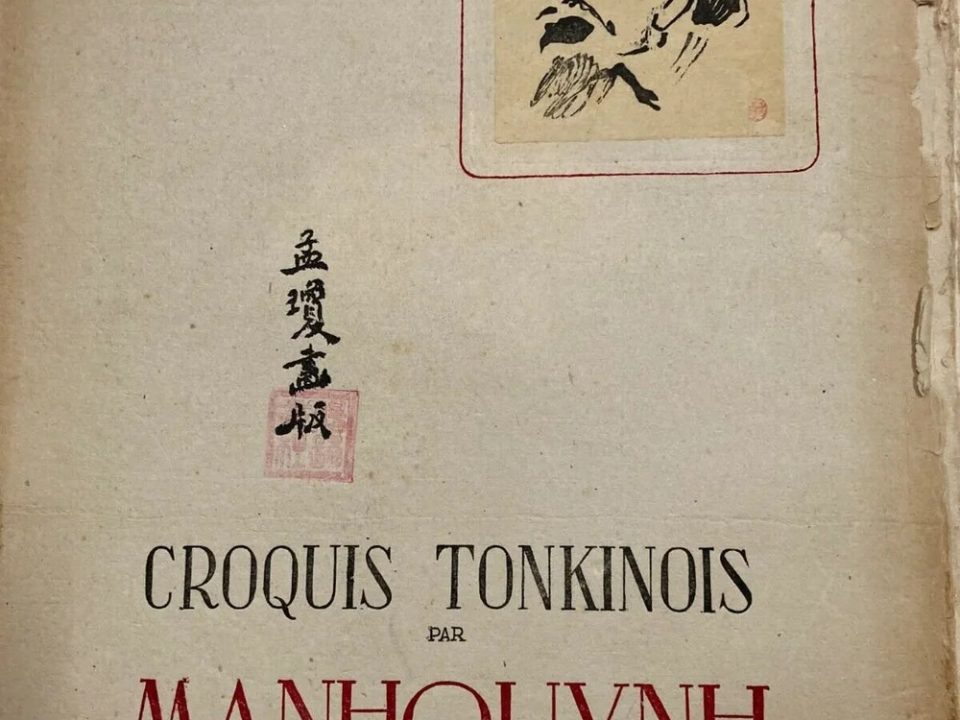
Painter Ngô Mạnh Quỳnh (1917–1991) graduated from the Lacquer Painting Department of the École des Beaux-Arts de l’Indochine in 1942. He was one of the earliest Vietnamese painters active in the press, even before enrolling at the school. In addition to painting, he collaborated with numerous well-known newspapers and created illustrations for works such as The Tale of Kiều, Lục Vân Tiên, and La Fontaine’s Fables.
Painter Nguyễn Trọng Hợp (1918–1999) studied in Class XIII (1939–1944) of the same art school. Besides oil and lacquer paintings, he also excelled in woodcuts and engraving, and was considered a master of black-and-white painting using ink and watercolor.
In this fifth installment of Indochina Memories, painter Nguyễn Đức Hòa—son of Nguyễn Trọng Hợp—recounts the struggles for daily survival in earlier times, and the connection between his father and Mạnh Quỳnh. All images accompanying the article were collected and provided by Đức Hòa.

An illustration by painter Mạnh Quỳnh depicting Thê Húc Bridge.
The two painters had known each other even before applying to the École des Beaux-Arts de l’Indochine, as my grandfather and Mạnh Quỳnh’s father both worked as clerks for the Yunnan Railway Company (Chemin de Fer du Yunnan), which operated the railway line from Hanoi to Kunming, China—constructed and monopolized by the French until 1945.
Mạnh Quỳnh entered the school first, studying lacquer painting—a department that, at the time, still trained artisans and was not yet considered equal to the main programs of painting and sculpture. However, he later received an official diploma from the school in 1942 after a new French regulation elevated lacquer painting to the same status as the other majors (a topic I’ll elaborate on in another article). My father graduated later, in 1944.
Those were the years when the entire world was in turmoil due to World War II (1939–1945). Even the École des Beaux-Arts de l’Indochine was not spared—a bombing raid by Allied forces in late 1943 destroyed one of its buildings, forcing all teachers and students to evacuate in three directions: Sơn Tây, Phủ Lý, and Đà Lạt.
Life became more difficult, and my father needed additional income. Unfortunately, he was not very socially connected. Thankfully, Mạnh Quỳnh was outgoing, quick-witted, and full of ideas. He always had painting jobs. When my father confided in him, Mạnh Quỳnh thought for a moment and said he would recommend him for illustration work in journalism—something suitable, time-flexible, and manageable for a student like my father.

Mạnh Quỳnh then introduced my father to the editorial office of Indochine Weekly, where he was actively collaborating. At that time, Mạnh Quỳnh was already famous for designing covers and illustrations for several newspapers.
Illustration back then was primarily done in black ink; color was rarely used, so techniques were kept minimal. Still, due to their personalities and drawing styles, while Mạnh Quỳnh would sketch with bold, sweeping strokes, my father was more reserved and meticulous. While Mạnh Quỳnh’s illustrations flowed effortlessly, my father’s appeared overly careful (something I would only fully understand later—artistic skill is one thing, but temperament plays a large role too).
Eventually, some of my father’s illustrations were accepted for print. But when he received his payment, he noticed it was always less than Mạnh Quỳnh’s. Curious, he timidly asked why. Mạnh Quỳnh looked into it and pointed out the reason: the newspaper’s accounting department paid based on the illustrated area—if a drawing left many blank spaces, the pay was lower. But if the drawing filled the designated space from edge to edge, even if there were some empty areas, it was still paid in full.
Surprised, my father carefully studied Mạnh Quỳnh’s sample illustrations. Despite being free and minimal in detail, they fully utilized the allotted space. So, my father adjusted his technique. His payments improved slightly, but his illustrations never quite reached the same expressive appeal. Mạnh Quỳnh’s work not only highlighted the story’s core but also conveyed a humorous, sharp personality. My father, no matter how hard he tried, couldn’t escape his naturally cautious style.
And illustration, after all, is about evocation—not detailed description! That’s why Mạnh Quỳnh’s illustrations were featured abundantly across several publications, while my father’s appeared sporadically—only rarely making the cover of Indochine Weekly.

Right photo: Indochine magazine cover, illustrated by painter Ngô Mạnh Quỳnh with the caption: “Tonkin – Phu Tho Landscape.”
My father had only one illustration ever published on the cover of Indochine Weekly. Despite being the cover, it was entirely in black and white. The drawing depicted a bustling countryside market scene beside an old village communal house, where women and girls in traditional thúng quai thao hats were busy buying and selling. True to my father’s personality, the image resembled a painting more than a typical illustration, with careful compositional planning and restrained brushwork.
Upon close inspection, it appears that the image was not reproduced via the usual etched zinc printing plates but rather using a traditional woodblock method. The artist would first draw on paper; then a craftsman would reverse-engrave the image onto a woodblock, which was then printed in the usual way. Today’s modern printing technologies have long abandoned such techniques, and few now remember that in the past, woodblock printing was a flourishing craft in Thăng Long during feudal times, and still active in colonial Hanoi. Artisans from villages like Hồng Lục and Liễu Tràng (in Hải Dương) had settled on Tô Tịch Street in the Old Quarter. They specialized in woodcarving for Buddhist scriptures, seals, decorative line art for Hàng Trống folk paintings, street shop ads, newspaper illustrations, and even assisted students from the École des Beaux-Arts de l’Indochine with their engraving coursework (a story for another article).

A painting by Nguyễn Trọng Hợp, signed in the lower left corner, featured on the cover of the Indochine weekly magazine in 1943.
Back to the aforementioned cover illustration: the main figure occupied so much space in the foreground that my father could not find a corner to sign his name. So, he used capital letters, leaving white space against the black-shaded area of the character—something that required meticulous drawing and smooth woodcarving.
In the end, although the drawing wasn’t bold or dynamic, it authentically portrayed a quintessential scene from the northern Vietnamese countryside of a not-so-distant past: a traditional market gathering by the village temple, with glimpses of the old-style hats no longer in use today. Perhaps for this reason, in 2019—seventy-four years after the newspaper ceased publication—the World Publishing House in Hanoi and Omega+ reissued Vietnam through the Indochine Weekly (1941–1944), curated and translated by Lưu Đình Tuân. The original cover drawing by my father was selected as the cover of the new book, being one of the most representative images of that bygone era.

From left to right: Painter Ngô Mạnh Quỳnh (4th from the left), painter Nguyễn Trọng Hợp (6th from the left), with fellow students from the École des Beaux-Arts de l’Indochine (Indochina School of Fine Arts).
Later, I learned that Mr. Mạnh Quỳnh also helped my father create miniature pyrography (woodburning) art on small wooden boards. This was in the mid-1980s, during the height of Vietnam’s economic hardship due to trade embargoes and ongoing conflicts on both northern and southwestern borders. With inflation eating away at civil servant wages, my parents sought extra income.
Around that time, Mr. Mạnh Quỳnh invited my father to No. 27 Đinh Tiên Hoàng Street—a private residence overlooking Hoàn Kiếm Lake and Ngọc Sơn Temple. The homeowner, Mr. Nguyễn Cao Sơn, had once studied at the École des Beaux-Arts de l’Indochine, in the same generation as renowned artist Nguyễn Gia Trí, though he had left school early. He was thus a senior to both my father and Mr. Quỳnh.
The house had a storefront selling books, newspapers, and cultural items, including miniature souvenir pyrography artworks on small wooden tiles. These were made by the owner, Mr. Quỳnh, and another nearby artist, Mr. Hoàng Lập Ngôn. The homeowner’s son, Mr. Cao Ái—also an art school graduate—taught my father how to use the tool: an electric stylus with a heated metal tip (made from coiled Soviet stove wire) that, when pressed onto wood, would burn and darken the surface. By carefully moving the tool, one could create detailed images.
Common themes included temples, lakes, Thê Húc Bridge, Turtle Tower, One-Pillar Pagoda, girls in áo dài—each sold for 3 đồng (about the cost of a bowl of phở at the time). Mr. Mạnh Quỳnh’s works always sold quickly, as they matched tourist tastes—especially among Swedes working on the Bãi Bằng Paper Mill project and Vietnamese expatriates visiting home.
In contrast, my father’s works sold very slowly. Mr. Quỳnh teased him: “Toi only draws in black and white—who’s going to buy that?” (In French, toi—pronounced “toa”—means “you”). Disheartened, my father brought the pieces home for my mother to add color to temple roofs, tree canopies, or blue skies. Still, sales remained sluggish. Later, my mother tried selling them at 2 Bà Triệu Street, a spot with more tourist foot traffic—but the outcome remained disappointing.
These are stories from a hard era for Vietnamese artists—times shaped by colonial rule, decades of war, embargoes, and border conflicts. Back then, people used to say, “Artists will starve to death with their heads in the water!” It’s precisely because of this that we continue to admire Mr. Mạnh Quỳnh. Unlike my father, who at least had a government salary, Mr. Quỳnh worked independently, thriving through his dynamism and creativity. He was beloved in Hanoi for teaching children how to paint, doing illustrations, and even appearing on local television to demonstrate puppet-making, shadow art, and simple animation.
Painter Nguyễn Đức Hòa
Edited and introduced by Sơn Ca
Original link: https://luxuo.vn/culture/ky-uc-dong-duong-5-hoa-si-manh-quynh-da-giup-bo-toi.html