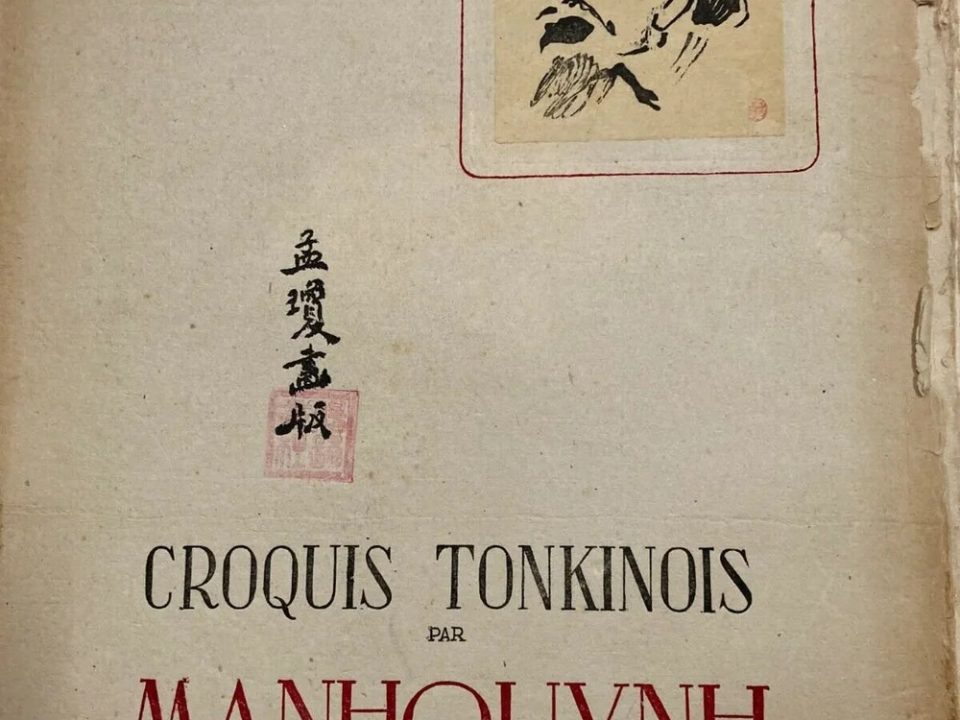
As the illustrator of the fables by French poet La Fontaine (1612–1695), Mạnh Quỳnh also illustrated The Tale of Kiều, created portraits of the legendary comedic duo Ba Giai – Tú Xuất, and contributed to bringing caricature characters like Lý Toét and Xã Xệ to life.
Let’s talk about a small story. While writing Love Stories of Vietnamese Historical Figures, Tales of Eminent People, and historical novels, I developed close friendships with descendants of these prominent individuals.
Recently, at the end of the year, I received quite a lot of documents about artist Mạnh Quỳnh from the post. It had been over ten years since I wrote the article Artist Mạnh Quỳnh and Poet La Fontaine—a piece I had nearly forgotten. Then one day, I received a call from the artist’s son, who mentioned that article. From that piece emerged a bond. A precious one. With these new documents, I feel inspired to write more.
Curiously, although Mạnh Quỳnh was a pioneering artist in Vietnamese comic storytelling, very little documentation about him exists.
Yet in the memory of his contemporaries, his presence remains vivid. He is remembered with admiration.
Poet Thy Ngọc, now in his eighties, recalled:
“When I was in 3rd or 4th grade, Mạnh Quỳnh was already famous. He drew adventure comics with mysterious titles like Kaoco, and illustrated the characters Vá and Vếu for the Cậu Ấm – Cô Chiêu children’s magazine, published by Thái Phỉ (Nguyễn Đức Phong).”
Cậu Ấm – Cô Chiêu was the first children’s newspaper in Vietnamese journalism. From issue No.1 to No.12 (first published on May 8, 1935), it was called Cậu Ấm (for boys). From issue No.13 (May 15, 1935), it was renamed Cậu Ấm – Cô Chiêu. The editorial office was located at 82 Rue du Coton (now Hàng Bông Street, Hanoi).
The magazine was printed in 19×29 cm format with 20 pages. Mạnh Quỳnh was the principal illustrator. Incidentally, it was through Cậu Ấm – Cô Chiêu that I later rediscovered and compiled the serialized novel Đảng Rỗ Bẩy by writer Nguyễn Công Hoan, which was republished by Trẻ Publishing House.

Poet Thy Ngọc continued:
“Mạnh Quỳnh was of the Ngô family. I remember him as tall and not very talkative, but youthful and always smiling—he gave a trustworthy impression. Besides comics, he was the first to create animated pictures shown in photo studios like Hạ Long.
Back then, before animation videos existed, children like us were fascinated by his picture ‘films’. He later opened an art class at his home on Hàng Trống Street (previously on Nhà Thương Khách Street). Many famous artists today were once his students.”
Thy Ngọc also noted that Mạnh Quỳnh illustrated the La Fontaine fables. He also illustrated The Tale of Kiều, drew Ba Giai, Tú Xuất, and played a key role in giving life to satirical characters like Lý Toét and Xã Xệ.
La Fontaine was first introduced in Vietnam with his name transliterated as “Lã Phụng Tiên” in Hải Lục Cách Ngôn, printed in Quốc Ngữ by Đỗ Thận and published by H. Schneider in Hanoi during the Đông Kinh Nghĩa Thục era.
The first fable to appear in Vietnamese press was The Wolf and the Lamb, translated by Nguyễn Văn Vĩnh (1882–1936), published in Đại Nam Đăng Cổ Tùng Báo (issue No.821 on October 10, 1907).
Nguyễn Văn Vĩnh later compiled and published La Fontaine: Fables (1928, Trung Bắc Tân Văn), containing 44 fables, all illustrated by Mạnh Quỳnh. His illustrations were infused with Vietnamese scenery and people. The book was republished by Cảo Thơm Publishing in the South in 1969, and again by Kim Đồng Publishing in October 2017 to mark Mạnh Quỳnh’s 100th birth anniversary.
Looking at his illustrations, one can’t help but smile. In the fable The Middle-Aged Man with Two Mistresses, for instance, the man wears a traditional Vietnamese turban and holds an umbrella, while the women wear mỏ quạ scarves and fan themselves. In The Milkmaid, the heroine Perrette looks just like a Vietnamese country girl from the early 20th century.
La Fontaine would surely have been delighted to see his fables given new life in such culturally distinct yet universally resonant ways.
The morals of these fables—“Don’t sell the bear’s skin before catching it,” “Know when to start rather than rush blindly,” “Doubt is the mother of safety,” or “An empty stomach has no ears”—are universal. Not just the French feel their truth; Vietnamese readers do too.
Particularly delightful are the animals in Mạnh Quỳnh’s fables. Even fierce creatures like lions and wolves appear with lovable, smiling faces under his brush.
Thanks to his unique vision, no Vietnamese artist to this day has illustrated La Fontaine’s fables more perfectly than Mạnh Quỳnh.
I used to think Nguyễn Văn Vĩnh was the first to translate La Fontaine’s fables into Vietnamese, starting in 1907. But later, I realized it was actually writer Trương Minh Ký who first translated them—in prose—from 1881, serialized in Gia Định Báo under the title Truyện Lang Sa Diễn Ra Quốc Ngữ.
Sometimes, writing about a famous figure’s family unexpectedly leads to real bonds. In my case, I’ve grown close to people like Vũ Mỵ Hằng (daughter of writer Vũ Trọng Phụng), Nguyễn Thị Thịnh (wife of Dr. Đỗ Xuân Hợp), Vân (daughter of writer Lê Văn Trương), An Kiều (son of artist Nam Sơn), and now Ngô Quỳnh Dũng, son of Mạnh Quỳnh.
Thanks to this connection, I’ve learned: Artist Mạnh Quỳnh, born 1917 in Hanoi, passed away on April 2, 1991. He studied at the École des Beaux-Arts de l’Indochine from 1932–1942, specializing in lacquer painting. He was among the first artists to inspire Vietnamese children to love art.
During his life, he published a six-volume drawing textbook Học Vẽ Phổ Thông (Basic Drawing Course). Fascinatingly, the back cover invited students to send their drawings to his home at 29 Hàng Trống for feedback—either in person or by post.
“Submissions should be rolled, not folded. For postal stamps, ask at the post office. Return postage is covered by the artist.”
How many young artists emerged from this class? In his own notebook, Mạnh Quỳnh once wrote:
“The most precious reward of my artistic career is training generations of young people in the path of painting.”
And not just that—countless people overcame illiteracy thanks to the illustrated educational materials he compiled.

This passage begins with a reflection from Mr. Ngô Đình Châu, the younger brother of artist Mạnh Quỳnh, recounting his memories during the resistance war:
“At that time, the Department of Mass Education (Bình dân học vụ – BDHV) of Interzone 10, led by Mr. Vương Kim Toàn, approached my brother to discuss illustrating and printing educational books for the interzone and nationwide, following the initiative of Mr. Nguyễn Công Mỹ, Director of the National Mass Education Department.
The first book commissioned by BDHV was Vần Quốc ngữ (Vietnamese Alphabet), followed by History of Vietnam and Geography of Vietnam. My brother was responsible for both illustrating and carving the blocks, and he oversaw the printing process. During wartime, there were no printing presses available—he had to organize hand-printing, producing twenty to thirty thousand copies of each title.
Setting up manual printing with woodblock carving required immense effort. He had to source the right kind of wood—only two types were suitable: thừng mực (a type of wild fig tree) or the fruit-bearing thị tree, known for their toughness and flexibility, essential for fine carving and durability.
Then, he needed to find the right ink. Only Lorieux printing ink from France could be used, as they were printing on giấy dó (traditional Vietnamese mulberry paper), and low-quality ink would smudge or bleed through.
Later, the Mass Education Department asked my brother to form a puppet troupe to tour the provinces, especially in the northern mountainous regions, for propaganda performances.”
Some of these educational books and precious documents from that time have been preserved—artist Ngô Quỳnh Dũng has generously shared photocopies. Among them is the 1947 publication I t Đoàn kết (I t Solidarity), published by the Yên Bái Mass Education Office. The cover shows a whimsical illustration of a white cat holding a black mouse reading a notebook, with a caption urging:
“I t, study hard and behave well,
To one day carry life’s burdens as well.”
The final page includes a four-line verse:
“Unite through I t,
Erase ignorance deep,
End the blindness of illiteracy,
For a bright life we keep.”
Another example is the Geography of Vietnam, published in 1948 by BDHV Interzone 10. It was also printed in large format and credited to “Mạnh Quỳnh – compiled, illustrated, and hand-printed.” His unique visual style shines through, deeply rooted in Vietnamese spirit and character—utterly distinct and unmistakable.
This same identity can be seen in earlier works like Lên tám (Turning Eight), published by Éditions Alexandre de Rhodes in 1944. The poet Tản Đà could not have foreseen that his children’s poetry would one day be reprinted with such exquisite illustrations.
One particularly charming image features a farmer resting on a grassy bank with his hoe beside him, while a child, an elder, and a woman stand nearby, all reading with focus and joy. The scene vividly illustrates the lines:
“Learning must be for all,
To build a common virtue.
Though knowledge may be little,
To learn is still to grow.”
Not only did Mạnh Quỳnh illustrate La Fontaine’s fables, but he also breathed life into Gulliver’s Travels to Lilliput and Brobdingnag, translated by Nguyễn Văn Vĩnh from Les Voyages de Gulliver à Lilliput et à Brobdingnag (published in 1944). Though the characters were European, their faces and attire bore Vietnamese features—offering a sense of familiarity to Vietnamese children, who felt like they were reading stories set close to home.
Similarly, in works like Children Singing, Children Playing (1943) and Old and New Vietnamese Villages (1945), Mạnh Quỳnh maintained this illustrative approach.
In doing so, he revealed the essence and soul of a gifted Vietnamese artist. Whether working in lacquer, sculpture, woodcut, or ink wash, when it came to illustration, he was determined to represent the Vietnamese identity—visible in every facial expression. That, too, is one of the hallmarks of artist Mạnh Quỳnh’s singular artistic legacy.
Le Van Nghe
Original link: https://cand.com.vn/Nhan-vat/11GITHANG-100-nam-hoa-si-Manh-Quynh-Mot-net-ve-cot-cach-hon-Viet-i458067/